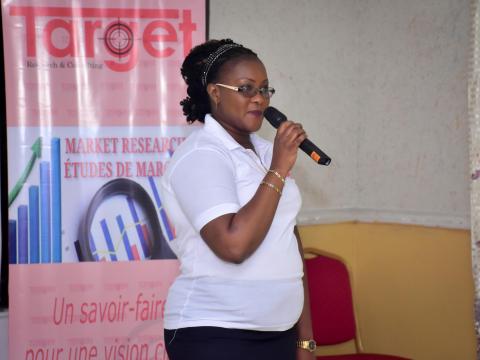
The Medias of Kinshasa have been invited this Wednesday, August 7, 2013 at the introduction of the results of the study “IMPACT OF ADVERTISING IN DR CONGO”,




Blaise Pezo: “data processing allows having consistent results”

Blaise PEZO holds the position of IT Manager within Target SARL since the creation of this market research agency, 2011 in DR Congo. Holding the highest leading position amongst a team of permanent IT agent as well as about fifty consultants, making sure that data collected from the field during a survey remains consistent and capable of providing, after analysis, useful information to help the client make rightful decision. For readers of Target website, he goes deep in explanation of twists and turns as regards a market research data collection.
Interview
What form does a research data collection take?
Data collection is a process aiming at pulling out information from rough data in order to come out with results. It firstly consists of creating a data base in questionnaire structure. Once data are collected, questionnaires shall be forwarded to encoders for data entry.
When it is about developing a soft questionnaire (using Smartphone or tablet), surveyors leading interviews on the field will directly record responses using the mobile device. All this is to give follow-up to both cleaning and double checking job for the said data with a view to producing results to be used during analysis stage.
Is that really important to make data processing?
Of course, since data processing allows avoiding absurd results and leads to accurate double checking in order to come out with consistent results.
Suppose that for a radio station that mainly broadcasts news, we get a score of 63% for music and 37% for news. Even before taking that data to other analysis, we will meticulously double check the related data to discover if the results are accurate or hedged. For that purpose we firstly proceed with a checking of codes’ recording (i.e. if the code 1 is equivalent to “news” and code 2 is equivalent to “music” have been accurately recorded and not inverted). Thereafter, we shall make sure that taken scores indeed correspond to the said radio.
This data processing stage is jointly performed with analysis for an analysis on the logic of results.
Data of what kind of researches do you process?
We mostly process quantitative researches’ data since they provide numbered data contrary to qualitative researches.
Researches such as positioning of brands, statistics on media, drink testing are examples of researches that require a computing data processing.
What are the main software you use for data processing?
For data processing, we use software such as Excel and Sphinx for cleaning of data. These both software allow us cancelling doublets, checking quotas, presenting graphics and checking responses’ consistency.
When you have in your profile a young man of 18 years old pretending to have post university education level (Master, PhD…), that means inconsistency. For this case we logically know that it is obvious not to have such education level at the age of 18 years old, unless you are exceptionally gifted. Which is rare.
There are also software such as SPSS, Sphinx and XLSTAT that we usually use for statistics’ analysis.
What measures do you take to keep confidentiality of data ordered by a client?
First of all to avoid disclosure of data, any person that is permanent staff or consultant having access to data due to the fact of processing is required to sign a confidentiality clause of which none – compliance thereof might lead to judicial proceedings. As regards storage, data are stored in an internal server with protected and limited access.
We make sure to carefully comply with International standards of ESOMAR that is the global gathering of market researches’ professional. This standards stipulate that “market research professional must fully comply with ethics and do nothing prejudicial to market research profession reputation.”
You are talking about external staff, do you mean that you also use consultants?
We do have permanent staff and we also use consultants especially when it comes to quantitative researches with greater sample and composed of a lot of questions to be processed.
Can clients have access to rough data as collected during survey?
It is possible that clients have access to rough data and very often rough data are sent in SAV. Format (format of SPSS data file). It is a format of file that can be consulted with any data processing software (Excel, lotus, Sphinx, SAS…) and that can also contain a maximum amount of information (more than 256 columns of information). Data can also be presented in Excel, provided that they have less information, about 256 variables (columns of information).
What professional relationships do you have with the team in charge of reporting?
With the team in charge of reporting, we firstly collaborate on production of performance indicators that present general tendencies of results, once performance indicators are produced, we design together a processing file as well as charts and graphics that shall be subjected to analysis in order to make preliminary, technical and final reporting.
Friday, August 21, 2015 - 18:23
Post date: Fri, 08/30/2013 - 17:41
Post date: Tue, 07/02/2013 - 09:16
TARGET’s participation in the SAMRA 2013 forum in Johannesburg (South Africa) has been the topic of an interview posted on the website mediacongo.net
Post date: Sat, 06/29/2013 - 08:30
The program “PANORAMA ECONOMIQUE” on Radio Okapi has received, this Saturday June 29, 2013 the General Manager of TARGET (Serge Mumbu) to comment on the econ
Post date: Fri, 05/31/2013 - 16:52
TARGET SPRL proceeded this Wednesday, May 29, 2013 by the presentation of the study “INDICES DE CONSOMMATION DES PRODUITS A KINSHASA” (2ème Editio
Post date: Fri, 05/31/2013 - 08:42
TARGET Managing Director (Serge Mumbu) attended SAMRA Conference 2013 that took place from 16 to 17 May 2013 at THABA YA BATSWAN
Post date: Tue, 05/07/2013 - 17:28
The Head office of TARGET SPRL is located since this may 2, 2013 in Building VULAMBO (ex SHELL) on the 8th floor (Boulevard du 30 Juin) number 152
Post date: Fri, 04/12/2013 - 16:53
TARGET has been selected by FEI (France Expertise Internationale) to achieve during the months of March and April 2013 a research of hearing media in 7 citie
Post date: Mon, 03/25/2013 - 15:49
Target Agency worked in partnership with INTERMEDIA (A research agency based at Washington DC, in USA) for the carrying out of a large survey on financial se
Post date: Tue, 03/05/2013 - 15:06
[[{"type":"media","view_mode":"media_large","fid":"210","attributes":{"alt":"","class":"media-image","height":"480","style":"wid